


From the Founder, Chairman, and CEO of Operation HOPE, John Hope Bryant.
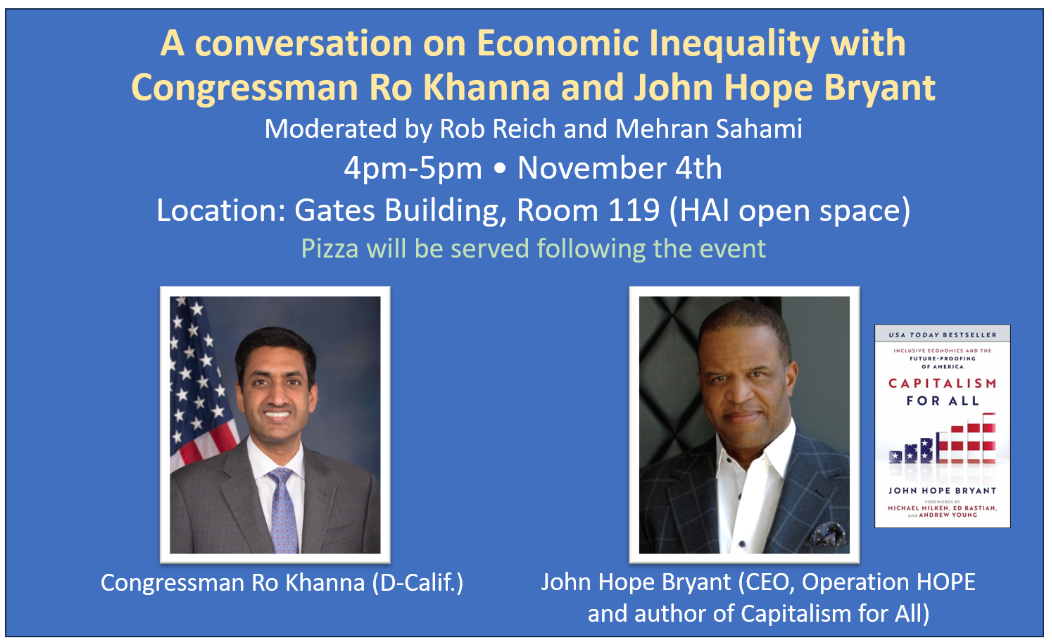
STANFORD, Calif. On Wednesday, November 4, John Hope Bryant, Founder, Chairman, and CEO of Operation HOPE, brought Capitalism for All to Stanford University for A Conversation on Economic Inequality with Congressman Ro Khanna (D-Calif.). The conversation took place in Room 119 of the Gates Building and was moderated by Mehran Sahami, chair of Stanford’s computer science department, and Rob Reich of the political science and philosophy departments.
Where does the participation problem begin?
John opened with the road that led him here: a childhood in Compton and South Central Los Angeles, and a first business started at ten, after a banker visited his classroom and showed him that someone could get rich legally by financing entrepreneurs. Operation HOPE, he told the room, is what happened when he decided to teach everyone else in his neighborhood how to reach capital.
From there he laid out four things he had written down on the way in. Income helps you survive, credit gives you access, assets create ownership, and ownership creates independence, with financial literacy tying all four together. “We don’t have a capitalist problem,” he said. “We have a participation problem.” He added that nobody teaches the rest of it either: “You make money during the day, you build wealth in your sleep.”
Why does America need a new Marshall plan?
John pointed back to the returning GIs after World War II, who were handed an education, an apprenticeship and a mortgage, and in doing so built the modern middle class. His case is that the country needs the same kind of plan for everyone now, which is the business plan he wrote Capitalism for All to be. He called this moment the third reconstruction, one that moves from civil rights to economic rights, from access to ownership. He also noted that living paycheck to paycheck reaches well into six-figure households, and that financial literacy and AI literacy together make up what he calls future literacy.
What did Congressman Khanna add?
Congressman Khanna took up the idea of inclusive prosperity and called for “America’s next new deal”: a shared floor of childcare, health care and education, paired with capital, financial literacy, apprenticeships and trade schools so that people can build intergenerational wealth and hold a real stake. On AI, he argued that guardrails are nothing new, pointing to the FAA, the SEC, the FDIC and the FDA as proof that America regulates powerful technologies and still gets the benefit of them.
Why does it take both the entrepreneur and the policymaker?
John made the case that neither side can do it alone. Philanthropy by itself is not the answer, he said, and the people with capital respond to a great business plan, which is why he writes books that read like one. He described the working model as constructive friction: one voice saying go, and another tapping the brakes. The room agreed, and the Q&A that followed ran from students asking how to move wealthy donors toward education to a question about where John’s own story began.
He closed with HOPE AI, the national effort he co-chairs with Van Jones, and with Juanita AI, the platform inspired by his mother, who worked 32 years at McDonnell Douglas Aircraft, kept a credit score of 854, and died a millionaire by doing the very things the evening was about.
Watch the conversation
John Hope Bryant is the Founder, Chairman, and CEO of Operation HOPE and the author of Capitalism for All: Inclusive Economics and the Future Proofing of America.