


From the Founder, Chairman, and CEO of Operation HOPE, John Hope Bryant.
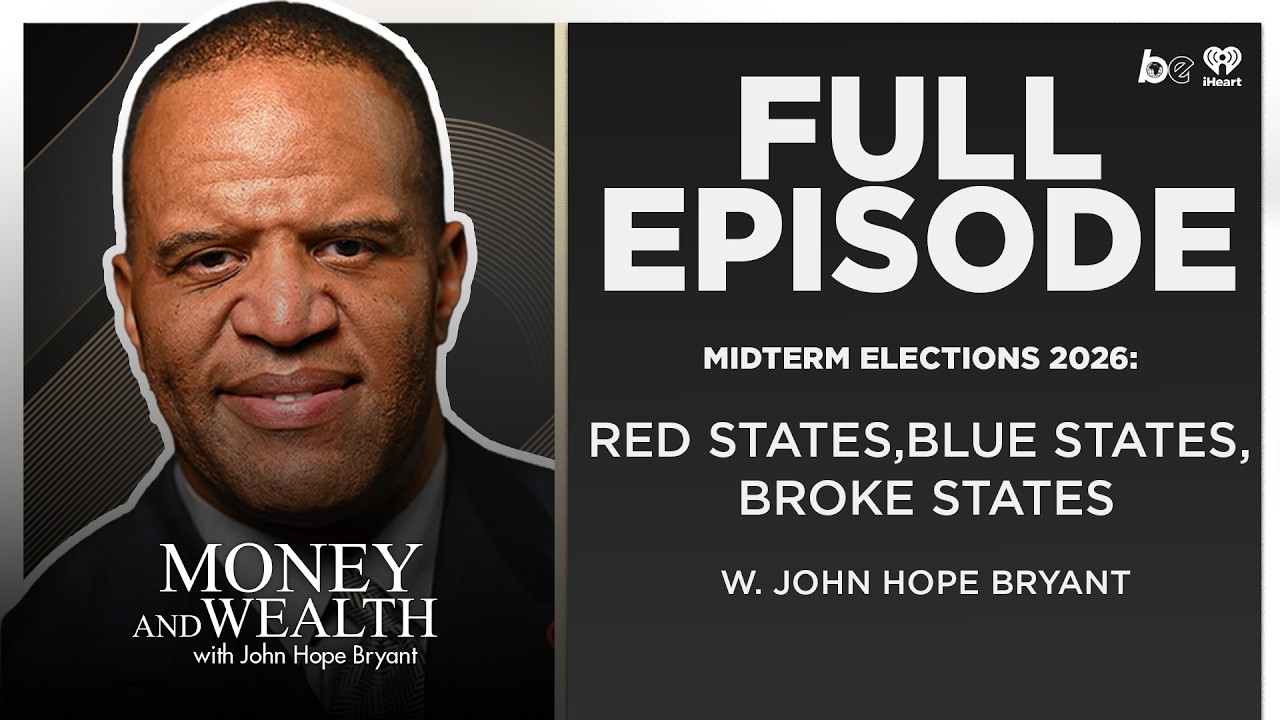
I do not talk about politics in a partisan way. My book, Capitalism for All, is 200 pages of math, and as my friend Melody Hobson says, math does not have an opinion. But this was midterm election week, and I recorded a special episode on how politics and money intersect, what deserves your attention and what you should ignore. Red states, blue states, broke states. Right now everybody has one thing in common: too much month at the end of the money.
The middle showed up
According to Gallup, just under half of America, about 44 to 45 percent, says it is politically independent, including me. About 27 percent are Republicans and about 27 percent are Democrats. Both parties have been messaging from the edges, and the people in the middle did not feel they had a voice. This week the middle showed up. My thesis is simple. Political power matters, but the real test of economic leadership is whether families can afford life, build resilience and gain some ownership. A lot of the socialism talk is really affordability in disguise. People are working one or two jobs plus a gig and still cannot afford their lives. I hear them say they hate rich people, and I say no, you do not. You hate rich people until you become rich. What you hate is a system where no matter how hard you work you cannot get ahead. At Operation HOPE, my answer is not to destroy the system. It is to help you ungame it.
Seven and seven
This election boiled down to seven and seven: about 7 percent interest rates tied to sustained inflation, and near $7 diesel. Voters were reminded of both every time they filled up a pickup truck. Seventy percent of our economy is consumer spending, and 70 percent of Americans are living paycheck to paycheck. Even at $100,000 a year, about half are. At $250,000 a year, about a third are. Neither party should get giddy. I believe the last presidential election was lost more than it was won, and this one was too. Republicans lost this time, which is different than Democrats winning. If anyone treats this as a broad mandate, they are going to be shown the door next. The mandate is narrow: make sure I can live a dignified life.
The F-250 test and the mortgage test
Take a contractor who needs a Ford F-250 to make a living. A $70,000 truck loan over 72 months runs about $1,095 a month at 4 percent and about $1,227 at 8 percent. Fuel at 20,000 miles a year and 15 miles per gallon is about 1,300 gallons, which at $7 a gallon is almost $10,000 a year before you make a single payment. Now the mortgage test. A $400,000 30-year fixed mortgage costs about $1,686 a month in principal and interest at 3 percent and about $2,661 at 7 percent. That is almost $1,000 more each month, before taxes and insurance. The house did not get bigger. The payment did. That is how an economy can grow while a family feels it is going backwards, and why people stopped asking about the rate and started asking what the payment is.
Perception is not causation
Let me be fair. Economic causation is complicated, and nobody can say a single party caused every interest rate or grocery bill. Mortgage rates follow long-term treasury yields, expected inflation, credit conditions and Federal Reserve policy. Oil and diesel reflect global supply, refining, taxes and geopolitics, and a war in the region where we get a lot of oil is not helpful. Lower inflation means prices rise more slowly, not that they fall, so do not expect gas prices to drop overnight. But political accountability is simpler. Voters hold whoever is in charge responsible for how they feel, and that is true for both parties. GDP is not your bank account, and a booming stock market is good news only if you own stocks. If you bought assets over the last 16 years and just sat on them, you might be wealthy. If you lived on cash flow, you might be broke. You make money during the day and you build wealth in your sleep.
History keeps repeating the lesson
In the 1970s an energy shock and inflation undermined confidence in economic leadership, and Jimmy Carter, a good and decent man, lost it. In 1992, a recession and household anxiety gave us the phrase, it’s the economy, stupid. I founded Operation HOPE on May 5, 1992, after the Rodney King riots. I liked George H.W. Bush as a person, but when he could not convince people he understood a grocery store bill, they concluded he could not represent their family. After the pandemic, inflation and affordability concerns put pressure on the Democratic administration, and I do not think they used all that money floating through the system to draw a direct line of sight to people’s quality of life. Politicians talk about national economic performance. Voters ask whether their own lives will get better. Those are related questions, not identical ones. And when you call affordability a hoax, you offend your own voters.
Collect like a capitalist
I told a group of socialists on a city council that even if you want to distribute money like a socialist, you first have to collect it like a capitalist. Somebody has to pay for it, and the numbers have to balance. If your outflow exceeds your inflow, your overhead will be your downfall. You also cannot simply cut your way out. We have to find a way to put everybody to work and grow our way out through economic empowerment, because individuals are the primary engine of the biggest economy in the world. I have been making this case to Democratic leaders too, including Representative Ro Khanna, with whom I had a conversation at Stanford University. Money is not evil. It is the love of money that is evil. Dumb, greed-based capitalism is what is bad.
Why ownership was never evenly spread
I walked through the history in Capitalism for All. The Homestead Act of 1862 supported land ownership for white settlers while Black and Native Americans were largely shut out. Federal redlining starved urban neighborhoods of mortgage insurance, so money, being a coward, went where the government was backing it. The Freedmen’s Savings Bank was chartered in 1865 and closed in 1874, and I see Operation HOPE as continuing its unfinished work. Immigrants are about 20 percent of GDP, women are a third of the economy, and Black and Latino households account for about $6.5 trillion of a $30 trillion economy. You cannot make an economy bigger by making its participants smaller. Dr. King’s march was for jobs and freedom, and I believe the next chapter of the movement is economic participation. If you are not at the table, you are on the menu.
My mother, again
My mother, Juanita Smith, earned $15 to $18 an hour at McDonnell Douglas, later Boeing, and built a net worth of about $1 million. Her example does not prove every family can become millionaires on low wages. Costs, timing, health and access to assets all matter, and as Michael Milken says, intelligence is equally distributed, opportunity is not. But it proves ownership and discipline can change a family’s trajectory. Know three numbers: income, cash flow and net worth. You need good wages and more ownership, not one or the other. You can talk with her through Juanita AI, which we created at Operation HOPE at no cost, and she can refer you to a HOPE financial coach.
Credit is infrastructure
Credit is not wealth, but it is a bridge to wealth. Detroit, which was the wealthiest city per capita in the world in 1950, has an average credit score of about 570. I have encouraged its leaders to build a 700 credit score community citywide. Our research found that in a 500 credit score neighborhood people live to about 61, and within a 15-minute drive in a 700 credit score neighborhood they live to about 81. For every 50-point increase, about five more years. It is trackable, measurable and has nothing to do with race or politics. That is also why I talk about child savings accounts. Operation HOPE now has 12,000 child savings accounts for kindergartners in Atlanta, a program the city expanded under Mayor Andre Dickens. Dr. Bernice King and I are discussing opening bank accounts in 100 cities ahead of her father’s 100th birthday.
The green agenda
If you win power promising affordability, the test is not the press conference. It is whether families can afford a home, finance a business, build a cushion against emergencies and share in neighborhood appreciation instead of being displaced by it. People resent what happens to them and support what they own. Nobody washes rental cars. I also believe AI is the new divide. Your job may not be taken by AI, but it may be taken by somebody who can use AI, and I want that somebody to be you. That is why we launched HOPE AI, which I am co-chairing with Van Jones, and Juanita AI.
Five votes every household can cast
One, vote to know your numbers: credit reports, monthly cash flow, debt, savings and net worth. Two, vote for resilience by starting an emergency fund and reducing expensive debt. Three, vote for ownership through diversified retirement investments, home equity or business ownership when appropriate. Four, vote for earning power. We are running out of plumbers and electricians, and you cannot AI plumbing. Five, vote for community. Mentor one person, support a local business, and consider joining HOPE Corps, where I want to grow volunteers to 10,000, 20,000 and 50,000, along with 10,000 HOPE Clubs by 2035.
Five tests for the leaders who won, and those who did not
Are inflation-adjusted household incomes improving? Are housing and borrowing costs becoming more manageable? Can new and existing small businesses reach capital and customers? Are more households building savings, retirement assets and equity? And are the gains reaching communities historically excluded from wealth creation, or only the wealthy? No political party deserves a blank check. Measure the results, reward what works, change what does not, and do not mistake a campaign slogan for an economic strategy.
America has spoken at the ballot box, but the work of building the American dream is not finished on election night. Democrats may celebrate, Republicans may regroup, independents may ask what happens next, and the American family still has bills to pay. Talent is everywhere. Aspiration is everywhere. Opportunity is not. I am trying to do something about that through our CIM BGV Impact Ventures partnership with CIM Group, where we are raising a billion dollars for an affordable housing fund.
Watch the full conversation
Listen to the full episode of Money & Wealth with John Hope Bryant on iHeart, on the Black Effect Podcast Network.
— John Hope Bryant
John Hope Bryant — founder of Bryant Group Ventures, Operation HOPE, Inc, publisher of the Bryant Journal and author of his 7th book Capitalism for All: Inclusive Economics and the Future Proofing of America, now a bestseller. Bryant was recently recognized as a member of the Forbes 250 Greatest Living Self Made Americans, on the occasion of the 250th anniversary of America itself. Get the book →